Lab: BGP FlowSpec on Arista EOS
Overview
This lab demonstrates BGP FlowSpec implementation on Arista EOS.
Lab files including Containerlab topology are available on GitHub.
Learning Objectives
- Configured BGP FlowSpec with different actions (discard, redirect).
Lab consists of following devices
igwispcustomerscrubberexabgp
Key protocols used
- BGP IPv4 unicast address family between
customer,igwandisp - BGP FlowSpec address family between
igwandexabgp
Lab exercices
Lab #1 - FlowSpec discard action
- The
exabgpis configured to advertise an IPv4 FlowSpec route that matches the source prefix 9.0.0.9/32 with discard action. - FlowSpec is enabled on the
igwrouter interfaceEthernet1. - Traffic tests are initiated from the
isprouter:- ICMP traffic sourced from 8.0.0.8 toward 203.0.113.0/24 on the
customerrouter is forwarded successfully. - ICMP traffic sourced from 9.0.0.9 toward the same destination is dropped by the
igwrouter as dictated by the FlowSpec policy.
- ICMP traffic sourced from 8.0.0.8 toward 203.0.113.0/24 on the
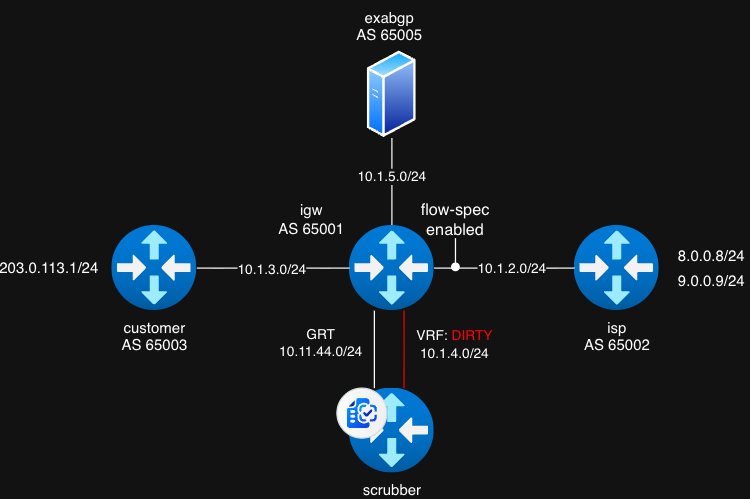
Complate ExaBGP configuration on exabgp including the IPv4 FlowSpec route:
template {
   neighbor as-65001 {
        local-as 65005;
        peer-as 65001;
        router-id 100.64.0.5;
        local-address 10.1.5.5;
        flow {
            route {
                match {
                    source 9.0.0.9/32;
                    }
                    then {
                        discard;
                    }
                }
            }
        family {
            ipv4 unicast;
            ipv6 unicast;
            ipv4 flow;
        }
        capability {
            route-refresh;
            graceful-restart;
            add-path send/receive;
        }
    }
}

neighbor 10.1.5.1 {
        inherit as-65001;
}
The following output confirms that the IPv4 FlowSpec route advertised by exabgp has been successfully received and accepted by the igw router:
igw#sh bgp flow-spec ipv4 summary
BGP summary information for VRF default
Router identifier 100.64.0.1, local AS number 65001
Neighbor Status Codes: m - Under maintenance
  Neighbor V AS           MsgRcvd   MsgSent  InQ OutQ  Up/Down State   RulesRcd RulesAcc RulesAdv
  10.1.5.5 4 65005              4         5    0    0 00:00:52 Estab   1      1      0
Detailed output of the IPv4 FlowSpec route on igw router:
igw#sh bgp flow-spec ipv4 detail
BGP Flow Specification rules for VRF default
Router identifier 100.64.0.1, local AS number 65001
BGP Flow Specification Matching Rule for *;9.0.0.9/32;
 Rule identifier: 3706191936
 Matching Rule:
   Destination Prefix: *
   Source Prefix: 9.0.0.9/32
 Paths: 1 available
 65005
    from 10.1.5.5 (100.64.0.5)
      Origin IGP, metric -, localpref 100, weight 0, valid, external, best
      Actions: Drop
FlowSpec must be explicitly enabled on the interface where rules are applied to incoming traffic (Ethernet1 on the igw router in this example):
igw#sh run int e1
interface Ethernet1
   description isp_Ethernet1
   no switchport
   flow-spec ipv4 ipv6
   ip address 10.1.2.1/24
The FlowSpec rule is successfully installed in hardware on the igw router and applied to the ingress interface Ethernet1:
igw#sh flow-spec ipv4 rule identifier 3706191936
Flow specification rules for VRF default
Configured on: Ethernet1
Applied on: Ethernet1
  Flow-spec rule: *;9.0.0.9/32;
    Rule identifier: 3706191936
    Matches:
      Source prefix: 9.0.0.9/32
    Actions:
      Drop
    Status:
      Installed: yes
      Counter: 0 packets, 0 bytes
Data plane verification allowed traffic - ping sourced from 8.0.0.8 toward detination 203.0.113.1 is forwarded successfully:
isp#ping 203.0.113.1 source 8.0.0.8
PING 203.0.113.1 (203.0.113.1) from 8.0.0.8 : 72(100) bytes of data.
80 bytes from 203.0.113.1: icmp_seq=1 ttl=63 time=1.51 ms
80 bytes from 203.0.113.1: icmp_seq=2 ttl=63 time=0.796 ms
80 bytes from 203.0.113.1: icmp_seq=3 ttl=63 time=0.736 ms
80 bytes from 203.0.113.1: icmp_seq=4 ttl=63 time=0.705 ms
80 bytes from 203.0.113.1: icmp_seq=5 ttl=63 time=0.631 ms

--- 203.0.113.1 ping statistics ---
5 packets transmitted, 5 received, 0% packet loss, time 5ms
rtt min/avg/max/mdev = 0.631/0.875/1.508/0.320 ms, ipg/ewma 1.251/1.177 ms
Data plane verification for blocked traffic - ping sourced from 9.0.0.9 toward the same destination is dropped by the igw router:
isp#ping 203.0.113.1 source 9.0.0.9
PING 203.0.113.1 (203.0.113.1) from 9.0.0.9 : 72(100) bytes of data.

--- 203.0.113.1 ping statistics ---
5 packets transmitted, 0 received, 100% packet loss, time 41ms
Lab #2 - FlowSpec redirect to a VRF
- The
exabgpis configured to advertise an IPv4 FlowSpec route that matches the source prefix 9.0.0.9/32 with redirect 666:666 (redirect to a VRF) action. - FlowSpec is enabled on the
igwrouter interfaceEthernet1. - Traffic tests are initiated from the
isprouter:- ICMP traffic sourced from 8.0.0.8 toward 203.0.113.0/24 on the
customerrouter is forwarded successfully. - ICMP traffic sourced from 9.0.0.9 toward the same destination is redirected by the
igwrouter into the DIRTY VRF (666:666) as dictated by the FlowSpec policy.
- ICMP traffic sourced from 8.0.0.8 toward 203.0.113.0/24 on the
Complate exabgp configuration for the Lab #2. The BGP FlowSpec route is modified to use the redirect 666:666 action (VRF redirection) instead of discard:
template {
   neighbor as-65001 {
        local-as 65005;
        peer-as 65001;
        router-id 100.64.0.5;
        local-address 10.1.5.5;
        flow {
            route {
                match {
                    source 9.0.0.9/32;
                    }
                    then {
                        redirect 666:666;
                    }
                }
            }
        family {
            ipv4 unicast;
            ipv6 unicast;
            ipv4 flow;
        }
        capability {
            route-refresh;
            graceful-restart;
            add-path send/receive;
        }
    }
}

neighbor 10.1.5.1 {
        inherit as-65001;
}
A new VRF instance DIRTY is defined on the igw:
vrf instance DIRTY
ip routing vrf DIRTY
!
interface Ethernet4.10
   encapsulation dot1q vlan 10
   vrf DIRTY
   ip address 10.1.4.1/24
!
ip route vrf DIRTY 0.0.0.0/0 Ethernet4.10 10.1.4.4 name to_scrubber
!
router bgp 65001
   vrf DIRTY
      rd 666:666
      route-target import vpn-ipv4 666:666
      route-target export vpn-ipv4 666:666
The updated IPv4 FlowSpec route with a redirect action to the DIRTY VRF (666:666) is successfully received and accepted by the igw router:
igw#sh bgp flow-spec ipv4
BGP Flow Specification rules for VRF default
Router identifier 100.64.0.1, local AS number 65001
Rule status codes: # - not installed, M - received from multiple peers
                   I - has interface-set community

    Matching Rule                                                Actions
    *;9.0.0.9/32;                                                Redirect-VRF:666:666 (DIRTY)
The following output shows detailed information for the IPv4 FlowSpec route on igw router:
igw#sh bgp flow-spec ipv4 detail
BGP Flow Specification rules for VRF default
Router identifier 100.64.0.1, local AS number 65001
BGP Flow Specification Matching Rule for *;9.0.0.9/32;
 Rule identifier: 3559129152
 Matching Rule:
   Destination Prefix: *
   Source Prefix: 9.0.0.9/32
 Paths: 1 available
 65005
    from 10.1.5.5 (100.64.0.5)
      Origin IGP, metric -, localpref 100, weight 0, valid, external, best
      Actions: Redirect-VRF:666:666 (DIRTY)
The FlowSpec rule is successfully installed in hardware on the igw router and applied to the ingress interface Ethernet1:
igw#sh flow-spec ipv4 rule identifier 3559129152
Flow specification rules for VRF default
Configured on: Ethernet1
Applied on: Ethernet1
  Flow-spec rule: *;9.0.0.9/32;
    Rule identifier: 3559129152
    Matches:
      Source prefix: 9.0.0.9/32
    Actions:
      Redirect: VRF DIRTY
                Route via next hop 0.0.0.0
    Status:
      Installed: yes
      Counter: 0 packets, 0 bytes
Traceroute initiated from 8.0.0.8 toward destination 203.0.113.1 is forwarded directly to the customer router without any redirection:
isp#traceroute 203.0.113.1 source lo1
traceroute to 203.0.113.1 (203.0.113.1), 30 hops max, 60 byte packets
 1  10.1.2.1 (10.1.2.1)  0.068 ms  0.011 ms  0.010 ms
 2  203.0.113.1 (203.0.113.1)  3.167 ms  3.285 ms  4.282 ms
In contrast, traceroute initiated from 9.0.0.9 toward the same destination is redirected via the scrubber router before reaching the customer:
isp#traceroute 203.0.113.1 source lo2
traceroute to 203.0.113.1 (203.0.113.1), 30 hops max, 60 byte packets
 1  10.1.2.1 (10.1.2.1)  0.070 ms  0.015 ms  0.013 ms
 2  * * *
 3  10.11.44.11 (10.11.44.11)  2.716 ms  3.533 ms  4.397 ms
 4  203.0.113.1 (203.0.113.1)  7.190 ms  7.265 ms  7.907 ms
A tcpdump capture on the scrubber confirms that the redirected traffic is forwarded as intended:
scrubber#bash tcpdump -i eth1
tcpdump: verbose output suppressed, use -v[v]... for full protocol decode
listening on eth1, link-type EN10MB (Ethernet), snapshot length 262144 bytes
22:39:09.581249 aa:c1:ab:c5:25:bd (oui Unknown) > aa:c1:ab:f2:1a:db (oui Unknown), ethertype 802.1Q (0x8100), length 78: vlan 10, p 0, ethertype IPv4 (0x0800), 9.0.0.9.55088 > 203.0.113.1.33437: UDP, length 32
22:39:09.581366 aa:c1:ab:c5:25:bd (oui Unknown) > aa:c1:ab:f2:1a:db (oui Unknown), ethertype 802.1Q (0x8100), length 78: vlan 10, p 0, ethertype IPv4 (0x0800), 9.0.0.9.45723 > 203.0.113.1.33438: UDP, length 32
22:39:09.581857 aa:c1:ab:c5:25:bd (oui Unknown) > aa:c1:ab:f2:1a:db (oui Unknown), ethertype 802.1Q (0x8100), length 78: vlan 10, p 0, ethertype IPv4 (0x0800), 9.0.0.9.57537 > 203.0.113.1.33439: UDP, length 32
22:39:09.581942 aa:c1:ab:c5:25:bd (oui Unknown) > aa:c1:ab:f2:1a:db (oui Unknown), ethertype 802.1Q (0x8100), length 78: vlan 10, p 0, ethertype IPv4 (0x0800), 9.0.0.9.41871 > 203.0.113.1.33440: UDP, length 32
22:39:09.582439 aa:c1:ab:c5:25:bd (oui Unknown) > aa:c1:ab:f2:1a:db (oui Unknown), ethertype 802.1Q (0x8100), length 78: vlan 10, p 0, ethertype IPv4 (0x0800), 9.0.0.9.60361 > 203.0.113.1.33441: UDP, length 32
22:39:09.582465 aa:c1:ab:f2:1a:db (oui Unknown) > aa:c1:ab:c5:25:bd (oui Unknown), ethertype 802.1Q (0x8100), length 78: vlan 20, p 0, ethertype IPv4 (0x0800), 9.0.0.9.41871 > 203.0.113.1.33440: UDP, length 32
[omitted]